Bialystok University of Technology researches the use of non-metallic reinforcement in concrete elements
26-11-2025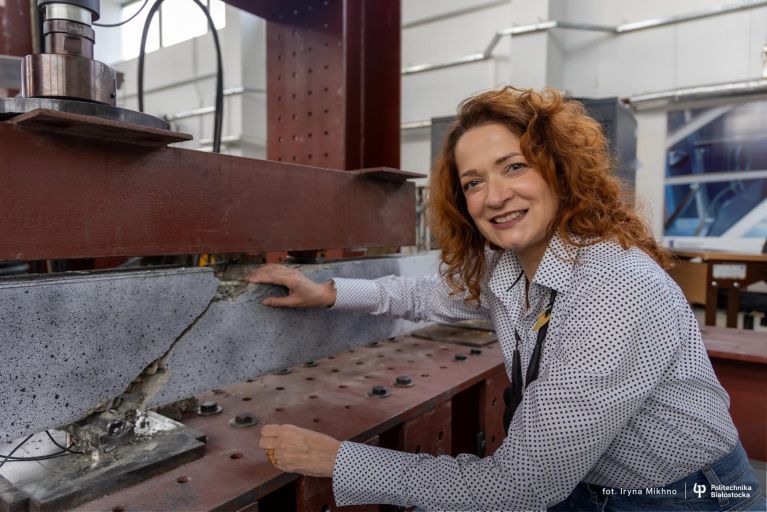
For a decade, Bialystok University of Technology has been studying the use of non-metallic reinforcement in concrete elements. Why did researchers from the Department of Building Structures and Structural Mechanics at the Faculty of Civil Engineering and Environmental Sciences focus their attention on this particular type of reinforcement for concrete structures?
– Non-metallic bars used as reinforcement are resistant to corrosion, including the effects of very strong chemicals – explains Assoc. Prof. Marta Kosior-Kazberuk, DSc, PhD, Eng. – They are magnetically, electrically and thermally neutral, have lower weight compared to steel and are easier to transport.
What else distinguishes traditional steel reinforcement from non-metallic bars?
– Composite bars have several times higher tensile strength compared to steel reinforcement – says the Rector of Bialystok University of Technology. – Of course, this is a major simplification of the strength characteristics of composites.
Since reinforced structures must operate under conditions of varied loads, researchers face a specific challenge.
– Composite bars have a several times lower longitudinal modulus of elasticity – admits Prof. Kosior-Kazberuk. – This requires the development of a new approach to the design of elements reinforced with non-metallic reinforcement.